Top 10 Tips To Assess The Compliance Of PAT With The Compliance Of PAT in Tamworth
The regulatory landscape for Portable Appliance Testing (PAT) in the UK is fundamentally different from the prescriptive requirements governing fixed electrical installations or fire safety equipment. Unlike the fire extinguisher testing that is subject to British Standards and third party certification schemes, the PAT test is governed under a health and safety framework which emphasizes duty of care and risk assessment rather than mandatory schedules for periodic testing. Electricity at Work Regulations (1989) state that electrical systems, including portable equipment, must be regularly maintained to avoid harm. The Regulations do however not mandate how maintenance is to be carried out, nor a frequency or method of testing. This places the onus on the dutyholder (typically the employer) to conduct a suitable and sufficient risk assessment to determine an appropriate maintenance and inspection regime. The compliance of a workplace is not determined by the number of test certificates. It is determined by the process of making risk-based decisions and implementing them competently.
1. Electricity at Work Regulations, 1989: The Legal Basis
Regulation 4(2), of the Electricity at Work Regulations, 1989, is the cornerstone for PAT compliance. It states: "As necessary to prevent dangers, all systems must be maintained to prevent such dangers, as far as it is reasonably practicable." This imposes an absolute duty on employers and dutyholders to maintain electrical equipment. The term "systems" includes portable appliances. Crucially, the regulations do not mention "PAT testing" specifically; they mandate "maintenance," which is a broader concept encompassing visual inspection, user checks, and combined inspection and testing. The type and frequency of maintenance is determined by the risk analysis, not by a legal deadline.
2. Act 1974 – Role of Health and Safety at Work Act 1974
The Health and Safety at Work Act 1974 is the main legislation that establishes employers' general duties towards employees and others. The main law that establishes what employers owe to their employees is the 1974 Health and Safety Act. In section 2 of the Act, employers are required to provide, as far as it is reasonable, for the health, safety, and welfare of their employees. This includes providing safe equipment, including electrical equipment. Section 3 extends this duty to persons not in their employment, such as visitors, contractors, and members of the public. PAT tests are a great way to ensure electrical equipment safety.
3. Code of Practice of IET for the In-Service Testing and Inspection of Electrical Equipment
While not law itself, the Institution of Engineering and Technology (IET) Code of Practice is the universally accepted benchmark for best practice in PAT testing. It contains detailed information on how you can implement a compliance maintenance regime.
Definitions and classifications of appliances.
The detailed procedures for formal visual checks and combined inspections.
The equipment type, operating environment and recommended inspection and test frequencies will determine the initial frequency.
Test results are graded as pass/fail.
Courts and Health and Safety Executives inspectors will use the code to determine whether or not a dutyholder’s regime of maintenance is "suitable and sufficiently." A deviation from the code that is not accompanied by a documented and robust risk-based justification can be interpreted as non-compliance with the regulations.
4. Risk Assessment: The Priority of Risk Assessment
HSE is clear in its support of a risk based approach to PAT tests, as opposed to the outdated notion of testing all equipment annually. The dutyholder is required to carry out a risk assessment before determining the nature and frequency of testing and inspection. This assessment is influenced by:
Equipment type: In a low-risk, double-insulated environment (Class II), a Class II appliance may only require a visual inspection. However, a Class 1 appliance in a workshop might need to undergo regular formal testing.
Environment: Construction sites and warehouses are high-risk environments. Offices, hotels and other places of business are typically lower-risk.
Users: Are equipment users trained staff or members of the public?
What is the history of your appliance? Is it new or has it been frequently damaged in the past?
This risk assessment defines a conforming system and not by the number of tests that have been conducted.
5. The concept of "Competence", for testers
Regulation 16 of 1989's Electricity at Work Regulations requires that those who work with electrical systems have the technical knowledge and expertise to prevent danger. For PAT, "competence", although not a formal qualification is required, must include:
Adequate knowledge of electricity.
The ability to work with the system in question and have an understanding of it.
Understanding the hazards involved and the precautions needed.
Ability to use test equipment correctly and interpret results.
City & Guilds' 2377 qualification is a very popular qualification, and it provides an excellent education. But competence can also be attained through other means. The duty holder must be able show that the person who conducts the testing is competent.
6. Documentation and Records-Keeping Requirements
The Electricity at Work Regulations do not explicitly require record-keeping. Regulation 29 says that it's a defense to prove you did everything possible and took due diligence in order to avoid the offence. Primary evidence of due care is comprehensive records. A compliant system of record-keeping should include the following:
A register of assets for equipment.
Documentation of the risk analysis and the maintenance plan.
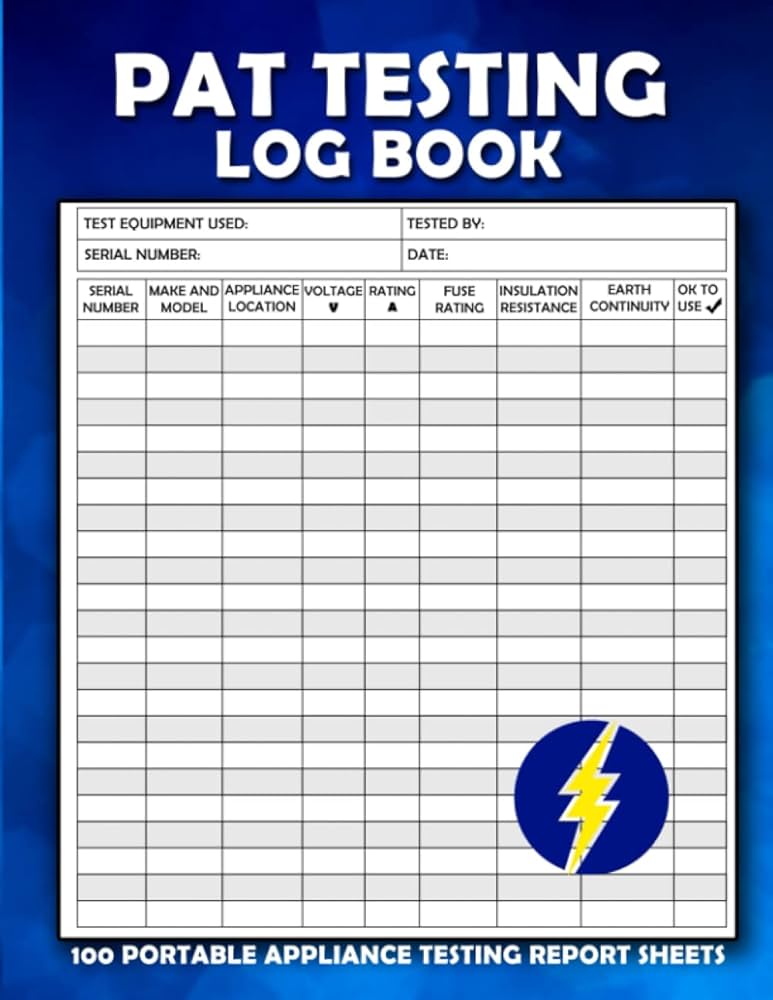
Reports for each inspection and test including the appliance description, results of tests, pass/fail status and date of next testing.
These records must be readily available for inspection by the HSE or local authorities.
7. Labelling and Identification of Appliances
Effective labelling plays a crucial role in a compliant PAT. Each appliance that has undergone a formal combined inspection and test should be labelled with:
The unique ID number of the asset that links it to the record.
The test date.
Date for next test (or inspection).
The name or identifier used to identify the tester.
Labels are a visual indicator for both users and inspectors of the appliance's status. Labels must be durable, nonmetallic and nonconductive.
8. The HSE Enforcement stance, and "Myth-busting"
The HSE actively works to clarify misconceptions related to PAT testing. They emphasize that:
No law requires that all equipment be tested annually.
Businesses can conduct their own testing if they have competent staff; there is no legal requirement to use a third-party contractor.
Visual inspection is more important than electronics testing, and can detect the majority faults.
An enforcement official will consider a risk-based strategy. A company that blindly tests all equipment each year without a supporting assessment of risk may be viewed as being less favorable than a firm that can justify the longer testing intervals for low-risk gear through a robust analysis.
9. Interplay with Other Legislation: PUWER 1998
The Provision and Use of Work Equipment Regulations of the year 1998 (PUWER), apply also to portable appliances. PUWER specifies that the work equipment used must be appropriate for its intended usage, maintained in a state of safety, and inspected periodically to ensure its safety. Regulation 6 specifies that inspections are necessary when the safety of electrical work equipment is affected by installation conditions. The PAT test is a vital method for meeting PUWER’s inspection and maintenance requirements for electrical equipment. This overlaps with the regulatory frameworks.
10. Due Diligence and Insurance Implications
While insurance companies have certain requirements, the law bases its assessment on risk. As a condition for coverage, a policy might stipulate that a third-party conducts PAT tests annually. A claim could be invalidated if this is not adhered to. Moreover, in the case of an electrical event, the dutyholder’s records for PAT tests and risk assessment are the first documents that insurers and HSE officials will scrutinize. A well-documented, risk-based system is the strongest possible evidence of due diligence and a robust defence against prosecution or a invalidated insurance claim. Take a look at the most popular Tamworth EICR inspections for site recommendations.
Ten Tips For Service Contracts On Fire Extinguisher Servicing in Tamworth
The decision to enter into an agreement for the maintenance of fire extinguishers is one that involves more than just cost. In the UK regulatory environment, which is controlled by the Regulatory Reform (Fire Safety) Order 2005 the service contract serves as the official mechanism by which the Responsible Person performs their legal duty to maintain fire-fighting equipment. A well-designed agreement is clear as it ensures compliance and sets out the roles of each party. Contracts that are poorly written can result in false assurances, concealed liabilities and compliance gaps. It is essential to comprehend the complex terms of these contracts starting from the inclusion of service clauses, to the pricing model to liability limitations and termination clauses prior to deciding on a firm to not only maintain but also to share your legal responsibility and to implement a comprehensive fire prevention strategy.
1. Contract Types: Full-Compliance vs. Time-and-Materials in Tamworth
Understanding the fundamental structure of your contract is crucial. A Full-Compliance Contract or an All-inclusive Contract is the most comprehensive. For a flat annual cost, the service provider is responsible for the entire schedule of services (annual, 5 years and 10 years) that includes parts, labor, and refill agent. They plan appointments ahead and make sure all work is documented. This approach is cost-effective and eliminates the risk that comes with unexpectedly high service costs. In contrast, a Time-and-Materials or Call-Out contract typically covers the annual basic service. Other work, such as repairs or a 5-year discharge testing is priced separately. This could result in unexpected costs and force you to work with more complicated service schedules.
2. Pricing Structure Transparency
A reliable contract will have a transparent and specific pricing structure. Examine the quote to ensure it details the cost completely. Does the offer include a price for each type of extinguisher? Does it have a separate item for the service annually and the projected cost for future extended services? It's important to be aware of any hidden fees. It is important to inquire about the mileage charge and call out charges administration charges, and the cost of replacing extinguishers that have been damaged or are out of date. A transparent estimate builds trust, and allows precise budgeting.
3. What's Included in the Scope of Service?
The contract's heart. It must be very clear which services are covered. The price is inclusive of:
All Basic Annual Services?
All extended 5 year services (discharge tests for foam, water, and powder)? in Tamworth
Do CO2 pressure tests and 10 year overhaul tests include all the CO2? in Tamworth
Repair of parts (seals or hoses, for instance, valves and pins).
Refill agents (powder or foam concentrate)? in Tamworth
Loan of equipment for repair work that will last for a long time? in Tamworth
Also important is the inclusion of a list of excluded items, including replacement for damaged or stolen units or repairs that are required in the event of malicious damage.
4. Scheduled Service and Visit Protocols
The contract should define the obligations of the provider regarding scheduling. Do they contact you to schedule an annual visit? What is the notice they will give? What are their procedures on arrival? Should they report at reception? Do they need to be accompanied? In addition, it should outline the time frame for an average service visit for your building's size and the process for conducting the service with the least disruption to your operation that is essential in high-traffic areas such as retail stores or hospitals.
5. Documentation and delivery of certificates in Tamworth
Documentation is a requirement of law and is not given as a service. The contract needs to clarify the manner in which certifications will take place and the date it will occur. Following each service, you need to be provided with a complete Service Report that lists all equipment serviced, the type of service provided, as well as any recommendations or errors identified. This document must be promptly provided as it is the main proof of compliance. The contract will also need to define the format of the document (e.g. Digital PDF, accessibility via an online portal, or a hard copy) and also who is going to receive it.
6. The fault resolution policy and the replacement of equipment in Tamworth
A critical clause describes the procedure for handling malfunctioning equipment. What is the definition of "beyond reasonable repair" by the provider? What's the process they use to condemn an extinguisher. The contract should clearly state who is responsible for replacement cost. If there is no exclusion (such as theft) the information must be stated in the contract. It should be stated in the contract to ensure that you're not left without protection for an extended time.
7. Time for Emergency and Reactive Work Response Times in Tamworth
Although scheduled visits are made but emergency situations aren't. The contract should specify the response of the provider to urgent circumstances, such as vandalism or an accidental discharge. Is there an exclusive phone number? What are the guaranteed callback durations and the response time of the engineer? The severity of an problem will usually determine the timeframe. These may also result in extra costs for certain contracts.
8. Indemnity and Liability Insurance in Tamworth
This is a vital legal protection. The contract will define the limits of Public Liability Insurance of the provider (e.g. 5 million PS 10, million PS) and Professional Indemnity Insurance. It is important to confirm that the insurance of the provider is current and adequate. Also, you should check for provisions that limit the liability of the company. The norm is to limit liability at the value of the contract. But, this must be reasonable.
9. Contract Termination, Renewal or Duration Clauses in Tamworth
Be aware of the commitment. Is this a roll-over contract, which runs on a calendar year, or is there a lock-in period of 3 or 5 years? What is the time frame for cancellation? Are there penalties for ending earlier? The renewal clause must state that the company will not automatically renew the contract without supplying a new quotation. You are entitled to end the contract if there is a breach, for example, if you consistently skip visits or do not provide certification.
10. Subcontracting Clauses and Assignment Clauses in Tamworth
Be sure to review every clause that allows the provider or contractor to assign a contract to another firm or subcontract any work. While subcontracting is common, your contract should state that any subcontractor employed must be able to demonstrate the same certification (e.g. BAFE SP101, for example) and have insurance as the main contractor. This will protect you against the risk of a reduction in standards and ensure the quality of the work is kept up to date. Take a look at the most popular fire safety in Tamworth for website recommendations.